
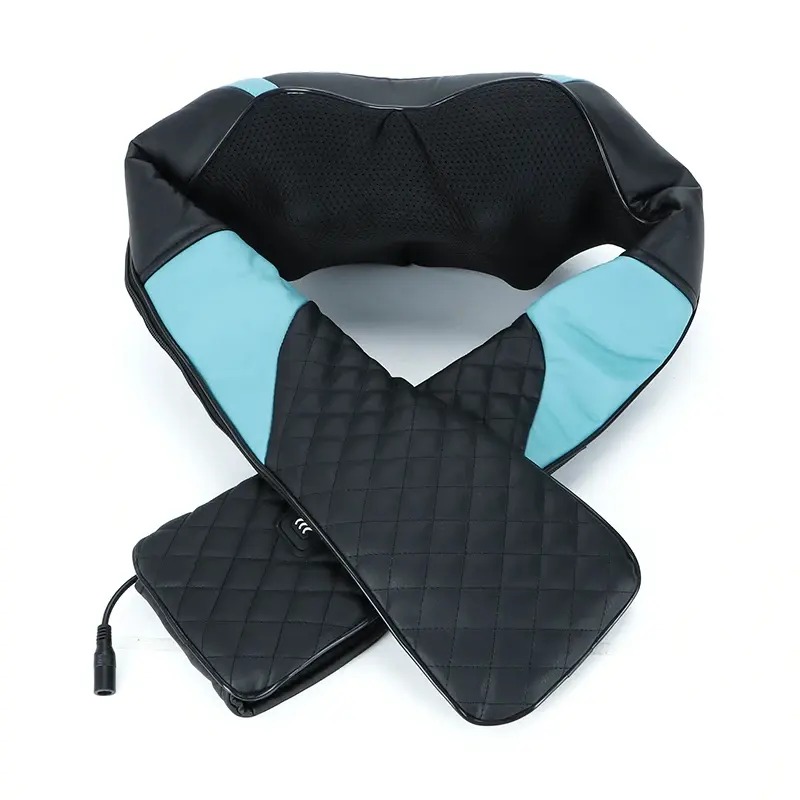
A shoulder massager sample earns or loses its place in your range on four things: how it drapes over clothing, how the surface material feels and wears, how far the kneading actually reaches, and how cleanly it switches between power modes. This checklist turns those observations into a repeatable record — the same format for every sample you compare, and a feedback document your supplier can act on.
Run the same evaluation on every sample under the same conditions, and record settings and results for each item.
Drape and wearing checks
| Check | What to do | What to record |
|---|---|---|
| Drape over clothing | Wear over a shirt and over a sweater | Fit change; position stability |
| Shoulder load | Wear for a full session | Comfort over time; strap pressure |
| Coverage | Check where kneading contacts vs where your copy claims | Zones reached: neck, trapezius, shoulder |
| Controller access | Operate all controls while worn | Reach, labeling, accidental presses |
PU surface and material checks (NM41, NM019, OY18NM01)
1. Inspect the PU surface for seam quality, color uniformity and surface texture across the whole unit.
2. Note any odor out of the box and after two hours unboxed — a practical proxy your customers will notice too.
3. Wipe the surface as a user would; check cleaning behavior for shared or demo use.
4. For custom colors, compare the sample against your color reference under daylight and store lighting, and record the deviation.
Because NM41 and NM019 list "Customized or as picture" color, the sample you approve defines the color standard for the order — photograph it under controlled light and attach the photos to the specification.
Massage performance checks
- Mechanism behavior: Film the roller shiatsu movement (NM41), shiatsu kneading (NM019), 3D kneading (HT-SN061) and deep kneading (OY18NM01). Confirm the movement matches the wording you plan to publish.
- Pressure and gears: Step through all settings; note whether adjacent settings feel distinct.
- Hot compress (NM019 — confirmed configuration): Measure warm-up time and temperature stability at the contact point with a surface thermometer. Listed settings need the supplier's measurement method and tolerance before any temperature claim goes into retail copy.
- Light features: For the infrared light (HT-SN061) and red light (OY18NM01), record what is visible during operation so your listing media shows the feature accurately.
Power and mode-switching checks
- Dual-power models (NM019, OY18NM01 — confirmed): Run a full session on mains power, then on battery. Compare strength and note any difference — this is a question your customers will ask.
- Plug-in models (HT-SN061, NM41): Verify the adapter, plug standard and cable length for your market.
- Battery models: Charge from empty with the supplied accessories, record charging time, and run repeated sessions under identical settings to build a comparable runtime figure.
Turning the results into supplier feedback
Send the completed checklist with photos or video for any failed item. Agree acceptance criteria in writing before production, keep the approved sample as the color and finish reference, and re-check changed items on a later approval sample.
Common sample questions
Should I test on multiple users?
Yes — drape fit varies more across body shapes than handheld devices. At least three users of different builds and clothing.
What is the most common failure?
Coverage claims: the massage reaches less area than the copy assumes. Film the actual contact zones and align your retail copy with the footage.
What if the PU color deviates from my reference?
Record the deviation and agree whether it is within tolerance. If not, the material batch changes before production.
Request shoulder massager samples with this checklist
Tell Relanovo which models to send and where. We will supply sample terms alongside this checklist so your evaluation and our feedback use the same format.